![[ChimeraX Issue Tracking System]](/trac/ChimeraX/chrome/site/ChimeraX-icon.svg)
#333 closed defect (fixed)
SSE cartoon extensions toward Nterm (no preceding linker) disjoint
| Reported by: | Elaine Meng | Owned by: | Conrad Huang |
|---|---|---|---|
| Priority: | major | Milestone: | |
| Component: | Depiction | Version: | |
| Keywords: | Cc: | ||
| Blocked By: | Blocking: | ||
| Notify when closed: | Platform: | all | |
| Project: | ChimeraX |
Description
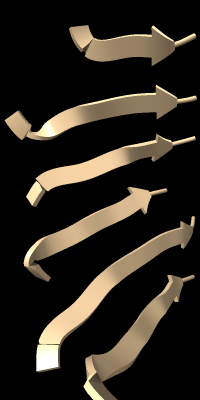
extensions of cartoon SSE representations toward the N-term are disjointed rather than smoothly connected to that SSE. For example, command: car link none c,s
The half-residue extensions on the N-term side are at different orientations than the rest of the strand, as shown in the attached image.
Attachments (1)
Change History (7)
by , 10 years ago
| Attachment: | badlinker.png added |
|---|
comment:1 by , 10 years ago
| Status: | new → accepted |
|---|
comment:2 by , 10 years ago
While working on a proposal for a simplified "cartoon" syntax, I had concluded that for a given type of SS (helix or strand), the ends really should be treated consistently. So instead of specifying by each type of join, one should really just specify strand treatment and helix treatment. That leaves 4 choices, shown with figures in my cartoon-proposal page:
http://www.cgl.ucsf.edu/home/meng/chimera2/user/commands/cartoon2.html
...factoring in your conclusions in the previous comment, I think we should just have 2 choices, short and long, with “short” the same as shown in the figure and “long” being what is now labeled as “Clong” in the figure. They could still be set separately for helix and strand. Personally I don’t mind having only those two choices, since I already believe that short should be the default.
comment:3 by , 10 years ago
I could live with it if it were only the linker issue in this ticket. However, if #361 is the same problem, that is more of a showstopper.
comment:5 by , 10 years ago
Rats, I thought you meant it was actually fixed. It's really a wontfix, is that right?
comment:6 by , 10 years ago
Yes. The first helix residue after a coil will always have a coil front half. This is enforced in the new "cartoon style" command.


I think this has to do with the change where we give up on continuity when going from coil to helix/strand because the cross section changes. Unfortunately, this also means that we cannot specify the linkage form where the second residue is completely helix/strand because the discontinuity is right in the middle of the residue. Here's a picture of the problem:
111111-222222-333333
N-CA-C-N-CA-C-N-CA-C
   sssssssSSSSSSS
       222222
There are three residues R1, R2 and R3. Each residue (and its ribbon) spans the three backbone atoms N, CA and C. The ribbon spline is calculated from CA-CA ("s" between R1 and R2 and "S" between R2 and R3). The ribbon for each residue is composed of two parts. In this example, the ribbon for R2 is the "back" half of spline "s" and the front half of spline "S".
Normally, "s" and "S" are continuous. However, we decided to add an exception where we remove the continuity requirement if the two residues are of different secondary structure types. We decided to do it this way because the ribbon often twists (as defined by the backbone carbonyl oxygen) significantly when the secondary structure changes. By introducing the discontinuity, we eliminate the twist constraint at these boundaries.
Now back to our example. Let's say that R1 is coil while R2 is helix. That means "s" and "S" are not continuous, which means if we display R2 using the same cross section throughout, we will see the discontinuity between splines "s" and "S". We cannot display the FIRST residue of a secondary structure using a single cross section because it is not continuous with the PRECEDING residue. Notice that the LAST residue in a secondary structure is fine, because its ribbon IS continuous with the preceding residue.
I think the simplest way is to disallow specifying cartoon linkage type for coil,anything. It is definitely a limitation, but it's difficult to fix unless we go back to more twisty ribbons at secondary structure boundaries. What do you think?