UCSF ChimeraX
UCSF ChimeraX (or simply ChimeraX)
is the next-generation molecular visualization program from the
Resource for Biocomputing,
Visualization, and Informatics (RBVI),
following UCSF Chimera.
ChimeraX can be downloaded free of charge
for academic, government, nonprofit, and personal use.
Commercial users, please see
ChimeraX commercial licensing.
ChimeraX is developed with support from National Institutes of Health R01-GM129325.
 ChimeraX on Bluesky:
@chimerax.ucsf.edu
ChimeraX on Bluesky:
@chimerax.ucsf.edu
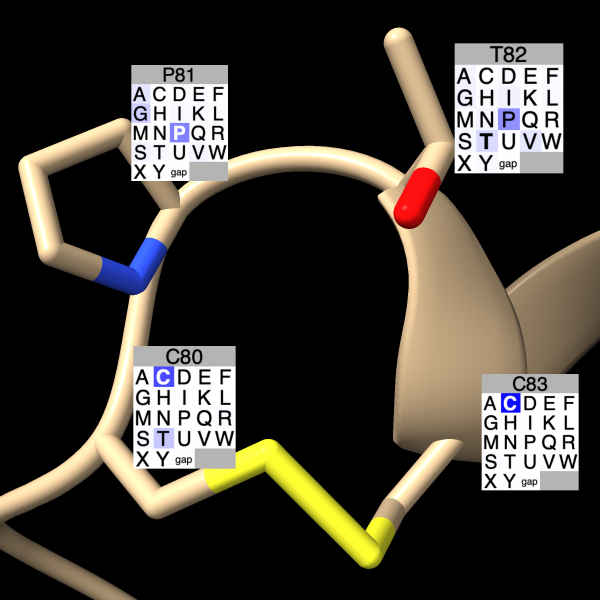
Residues can be labeled with color-coded grids showing conservation in
an associated
Profile Grid
multiple sequence alignment.
The image shows conservation within a disulfide-bonded loop
(chain B residues 80-83) of PDB
2B1L
based on a redoxin-superfamily sequence alignment.
Conservation grid labels can be shown using the
Profile
Grid context menu or the
sequence
grid label command in ChimeraX v1.12 from May 2026 and newer.
More features...
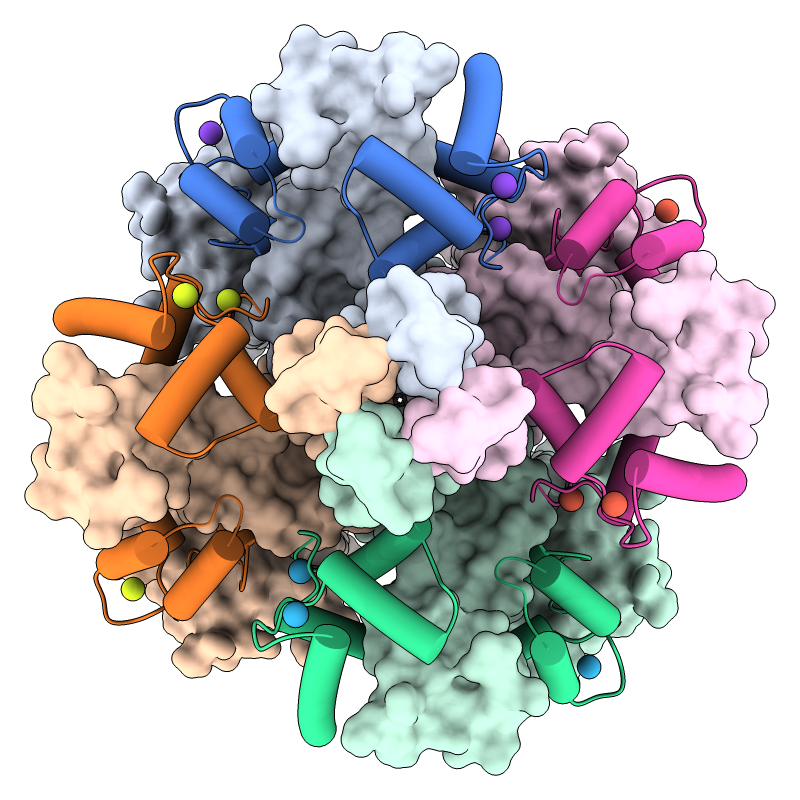
KCNQ1 is the pore-forming subunit of a cardiac potassium channel.
It binds to calmodulin, and mutations in either of these proteins
can cause congenital long QT syndrome, a dangerous
propensity for irregular heartbeats.
In the image, a structure of the KCNQ1/calmodulin complex
(PDB 5vms)
has been assembled into the native tetrameric form with the
sym command.
The view is from the cytoplasmic side, with
KCNQ1 shown as surfaces, calmodulin as cartoons, and calcium ions as balls.
A pastel palette
from ColorBrewer
has been used to color the surfaces, darkened with
color modify
for the cartoons, and “rotated” 45° in hue for the ions.
See the command file colormod.cxc.
More images...